
 Brands
 Best Selling
 Offer
Offer Combo
ComboIf you have ever shopped for skincare, you have undoubtedly seen those three little letters plastered across bottles, tubes, and sprays: SPF. You probably know that wearing it is the golden rule of skincare, heavily endorsed by dermatologists and beauty experts alike.
But what is SPF in sunscreen, exactly? How does it protect your skin, and what is the real difference between SPF 30 and SPF 50? With so many numbers, plus signs, and confusing labels, finding the right protection can feel overwhelming.
As your skincare educator, I have put together this complete guide to break down the science of sun protection. By the end of this post, you will understand exactly how sunscreen works, how to read the labels, and how to choose the perfect formula for your unique skin type.
What is SPF in Sunscreen ?
The SPF meaning is quite simple: it stands for Sun Protection Factor.
SPF is a scientific measure of how well a sunscreen will protect your skin from UVB rays, the specific type of radiation that causes sunburns and contributes to skin cancer. It is the universal standard used across the skincare industry to indicate a product’s defensive strength.
Think of SPF as your skin’s personal shield. When you step outside, the sun bombards your skin with invisible ultraviolet (UV) energy. An SPF rating tells you how much of that burning energy your sunscreen can absorb or reflect before it damages your skin cells.
What Does SPF Measure?
A common misconception is that SPF measures the minutes you can stay in the sun. Many people believe that if they normally burn in 10 minutes, an SPF 30 means they can stay out for 300 minutes (10 x 30). This is incorrect.
SPF actually measures the amount of solar energy (UV exposure) required to produce a sunburn on protected skin, compared to unprotected skin.
Because the intensity of the sun changes throughout the day, solar energy does not equate perfectly to time. For example, your skin absorbs much more solar energy during one hour in the direct midday sun than it does during one hour of early morning exposure. Therefore, an SPF 30 provides 30 times the protection against burning energy, regardless of exactly how many minutes pass.
How SPF Protects Your Skin
To truly understand the value of sun protection, it helps to know exactly how sunscreen works. Sunscreens use active ingredients to intercept UV rays before they can penetrate your skin and mutate your DNA.
These active ingredients fall into two main categories:
- Chemical Sunscreens (Absorbers): These contain carbon-based compounds like avobenzone, octisalate, and oxybenzone. They work like a sponge, absorbing UV rays, converting them into a negligible amount of heat, and releasing that heat from the skin.
- Physical/Mineral Sunscreens (Reflectors): These rely on minerals like zinc oxide or titanium dioxide. They sit on the surface of your skin and act like a mirror, deflecting and scattering UV rays away from your body.
Many modern formulas use a combination of both chemical and physical filters to provide an elegant, lightweight finish with maximum protection.
Understanding UVA, UVB, and Broad-Spectrum Protection
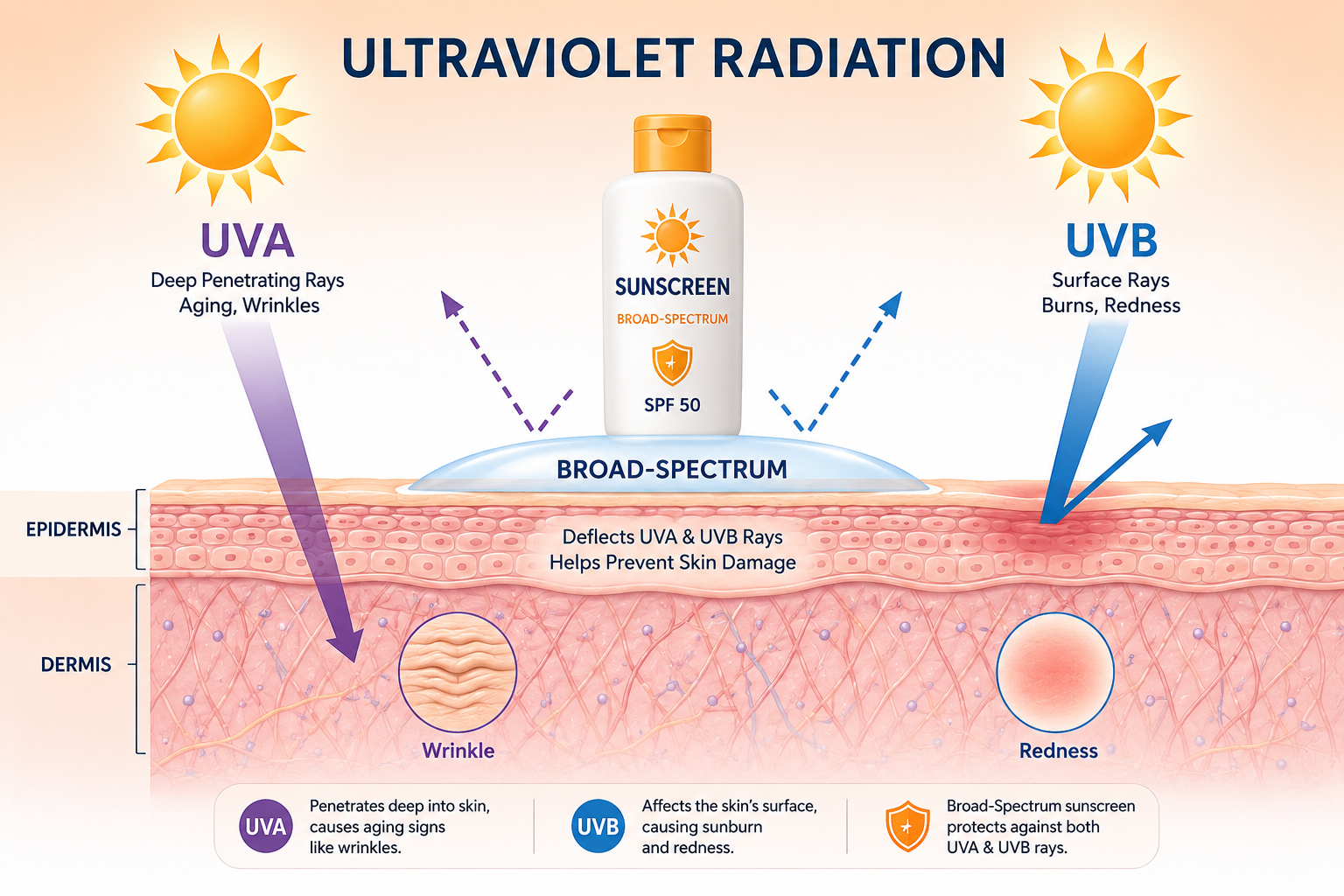
When discussing sun damage, we are primarily talking about two types of ultraviolet radiation. Understanding UVA vs UVB rays is critical for choosing the right product.
| Ray Type | The Damage It Causes | Easy Way to Remember |
|---|---|---|
| UVA Rays | Premature aging, wrinkles, dark spots, genetic damage. | A is for Aging. |
| UVB Rays | Sunburns, redness, direct damage to the skin’s outer layer. | B is for Burning. |
Here is the catch: SPF only measures protection against UVB rays.
If you use a sunscreen with a high SPF that doesn’t block UVA rays, you won’t get a sunburn, but your skin will still suffer from deep, wrinkle-causing damage.
To protect against both, you must use a broad-spectrum sunscreen. When a label says “broad-spectrum,” it means the FDA (or relevant local health authority) has verified that the product protects against both UVA and UVB radiation proportionally.
What Does PA+, PA++, PA+++, and PA++++ Mean?
If you use Korean or Japanese skincare, you have likely seen the letters “PA” followed by several plus signs.
While SPF measures UVB protection, the PA rating system measures UVA protection. Developed in Japan, PA stands for Protection Grade of UVA. It is based on the Persistent Pigment Darkening (PPD) method, which measures how much time it takes for the skin to tan.
Here is the PA+++ meaning broken down:
- PA+: Some UVA protection.
- PA++: Moderate UVA protection.
- PA+++: High UVA protection (Excellent for daily, incidental sun exposure).
- PA++++: Extremely high UVA protection (Best for long days outdoors).
For optimal anti-aging and health benefits, look for a sunscreen that boasts both a high SPF number (broad-spectrum) and a high PA rating (PA+++ or higher).
SPF 15 vs SPF 30 vs SPF 50 vs SPF 100
One of the most frequently asked questions in skincare is the difference between SPF numbers. Does SPF 100 offer double the protection of SPF 50? Not exactly.
The protection scale is not linear; it is incremental. Let’s look at the breakdown of SPF 30 vs SPF 50 and others:
| SPF Level | Percentage of UVB Rays Blocked | Who Should Use It |
|---|---|---|
| SPF 15 | Blocks 93% of UVB rays | Only for very brief, incidental indoor/outdoor transitions. |
| SPF 30 | Blocks 97% of UVB rays | The dermatologist-recommended minimum for daily use. |
| SPF 50 | Blocks 98% of UVB rays | Ideal for extended outdoor time or those prone to pigmentation. |
| SPF 100 | Blocks 99% of UVB rays | Best for highly sun-sensitive individuals or medical conditions. |
As you can see, the jump from SPF 30 to SPF 50 only offers a 1% increase in protection. No sunscreen can block 100% of UV rays.
Instead of chasing the highest possible number, dermatologists recommend choosing an SPF between 30 and 50 and focusing entirely on applying it generously and reapplying it consistently.
How Much Sunscreen Should You Apply?
The biggest mistake people make with SPF is not applying enough. If you only apply a pea-sized amount of SPF 50, you are likely only getting the protection of an SPF 15.
The Two-Finger Rule: For your face and neck, squeeze a line of sunscreen down the entire length of your index and middle fingers. This amounts to roughly 1/4 teaspoon, which is the scientifically tested amount required to achieve the SPF listed on the bottle.
Reapplication is Non-Negotiable: Sunscreen degrades as it absorbs UV energy and mixes with your natural sebum and sweat. You must reapply your sunscreen every two hours if you are outdoors, or immediately after swimming or heavy sweating.
Common Myths About SPF
Even with all the education available, sunscreen myths persist. Let’s debunk the most common ones:
- Myth 1: Dark skin doesn’t need sunscreen.
- Fact: While more melanin provides a slightly higher natural SPF (around SPF 13), it is not nearly enough to prevent UV damage, hyperpigmentation, or skin cancer. Everyone, regardless of skin tone, needs SPF.
- Myth 2: My makeup has SPF, so I’m covered.
- Fact: To get the SPF 30 protection advertised in your foundation, you would need to apply a thick, mask-like layer of makeup. Makeup SPF is a great bonus, but it cannot replace your primary sunscreen.
- Myth 3: I don’t need SPF indoors.
- Fact: While glass blocks UVB (burning) rays, up to 75% of UVA (aging) rays can penetrate standard windows. If you sit near a window, you are accumulating sun damage.
How to Choose the Right SPF for Your Skin Type
The best sunscreen is the one you enjoy wearing every single day. Modern formulations have evolved dramatically, meaning you never have to settle for a thick, greasy, white paste. Here is how to shop for your specific needs:
Sunscreen for Oily Skin
If you struggle with excess sebum and breakouts, look for chemical sunscreens or ultra-lightweight mineral formulas labeled “non-comedogenic,” “oil-free,” or “matte finish.” Ingredients like niacinamide or silica can help control shine throughout the day. Gel-based sunscreens are usually a perfect match.
Sunscreen for Dry Skin
If your skin feels tight and flaky, your sunscreen should double as a moisturizer. Look for creamy, hydrating formulas packed with nourishing ingredients like hyaluronic acid, ceramides, glycerin, and squalane.
Best Sunscreen in Bangladesh
If you live in a hot, humid climate like Bangladesh, your sunscreen needs to be resilient. The best sunscreen in Bangladesh will be lightweight, sweat-resistant, and non-greasy so it doesn’t melt off your face during the intense summer months. Korean and Japanese sunscreens are particularly famous for their water-like, elegant textures that perform beautifully in high humidity.
Ready to find your perfect match? You don’t have to look far to find high-quality, authentic sun protection.Browse sunscreens at Modern Beauty BDto explore a curated collection of top-tier SPF products tailored for every skin type and climate.

Why You Should Wear Sunscreen Every Day
Applying a daily sunscreen is the single most important step in any skincare routine. You can spend thousands on expensive serums, retinoids, and facials, but if you aren’t protecting your skin from the sun, you are undoing all that hard work.
Here is why daily SPF is mandatory:
- Prevents Premature Aging: UV exposure is responsible for up to 80% of visible facial aging. Daily SPF prevents the breakdown of collagen and elastin, keeping skin firm and plump.
- Fades Hyperpigmentation: If you have acne scars, melasma, or sun spots, UV rays will darken them. Sunscreen allows your skin to heal and ensures your brightening serums actually work.
- Reduces Cancer Risk: Consistent, daily use of SPF 15 or higher can reduce your risk of developing squamous cell carcinoma by about 40%, and lower your melanoma risk by 50%.
- Protects Skin Barrier: UV radiation weakens the skin barrier, leading to moisture loss and increased sensitivity. SPF acts as an external shield to keep your barrier intact.
Frequently Asked Questions
Does sunscreen expire?
Yes. Sunscreen active ingredients break down over time. Check the expiration date on the bottle. If there isn’t one, the FDA considers sunscreen effective for up to three years. If the texture, color, or smell has changed, throw it away.
Can I mix my sunscreen with moisturizer or foundation?
No. Mixing sunscreen with other products dilutes the active ingredients and disrupts the formula, resulting in patchy, ineffective protection. Apply your moisturizer first, let it absorb, and then apply your sunscreen as a dedicated layer.
What is the difference between sunblock and sunscreen?
Historically, “sunblock” referred to physical/mineral filters (zinc oxide) that sat on the skin, while “sunscreen” referred to chemical filters. Today, regulations prohibit the term “sunblock” because no product can completely block the sun. They are all referred to as sunscreens.
Should I apply sunscreen before or after moisturizer?
Sunscreen should always be the final step in your daytime skincare routine, applied after your moisturizer but before your makeup.
Are chemical sunscreens safe?
Yes. Chemical sunscreens are rigorously tested and approved by health authorities worldwide. However, if you have highly sensitive skin, rosacea, or eczema, you may find that physical/mineral sunscreens are gentler on your skin.
Do I need sunscreen in the winter or on cloudy days?
Absolutely. Up to 80% of the sun’s UV rays can pass through clouds. Snow also reflects up to 80% of UV rays, meaning you get hit by the sun twice—once from above, and once from the reflection on the ground.
How do I reapply sunscreen over makeup?
Reapplying over a full face of makeup can be tricky. You can use an SPF setting spray, a mineral powder sunscreen, or gently press a chemical sunscreen into the skin using a beauty sponge so you don’t disturb your foundation.
Final Thoughts
Understanding what is SPF in sunscreen is the first step toward achieving your healthiest skin. It is not just a summer accessory for days at the beach; it is a daily, non-negotiable healthcare requirement.
Whether you opt for a glowing, hydrating cream or a matte, oil-control gel, the most effective sunscreen is simply the one you apply generously every morning. Look for broad-spectrum protection, an SPF of 30 or higher, and an elegant formula that makes you look forward to wearing it.
Don’t wait until the damage is already done to start protecting your skin. Start your suncare journey today by exploring high-quality, authentic formulas suited perfectly for your needs.


